








25–26 May 2026 | Winnipeg, Canada
North America’s leading crisis training program returns to Winnipeg. Registration is now open.
After sold-out editions across North America, Crisis Communications Boot Camp – Winnipeg 2 delivers two intensive days of advanced crisis strategy, real-world case studies, and practical decision-making for senior communicators navigating polarization, misinformation, AI-driven risk, and constant scrutiny.
This is not theory. It is hands-on, senior-level training built for professionals who advise leaders, manage reputational risk, and protect trust when every decision is under pressure.
Hear directly from crisis leaders who have managed high-stakes situations inside organizations such as Accenture, Sun Life, the Ontario Centre of Innovation, the City of Ottawa, Princess Margaret Cancer Foundation and Princess Margaret Cancer Centre within University Health Network, the City of Denton, and Navigator Ltd..
No hypotheticals. Just what worked, what failed, and what they would do differently when trust, leadership credibility, and public confidence were on the line.
Senior communications, public affairs, corporate affairs, and crisis leaders who are expected to lead when the stakes are high and the margin for error is zero.
Trusted by 3,000+ communicators across the U.S. and Canada, with editions in Miami, Los Angeles, New York, Austin, Salt Lake City, Vancouver, Calgary, Toronto, Montreal and Mexico City.
Hosted in Toronto, Montreal, Vancouver, Zurich, Brussels, London, Doha, Dubai, Singapore, and across North America.
Limited to 70 participants to ensure hands-on learning, meaningful discussion, and direct access to experts.
Practical frameworks, tested case studies, and tools built for high-pressure, real-life scenarios.
Princess Margaret Cancer Foundation, Princess Margaret Cancer Centre, UHN
In today’s always-on media environment, crises rarely happen in isolation—and when they overlap, the real challenge becomes communication control, not issue management. This session explores how communications leaders can run multiple crisis narratives in parallel without losing clarity, consistency, or credibility. Tammy Scott will share practical approaches to prioritizing messages, sequencing disclosures, aligning internal and external communications, and protecting trust when attention, resources, and leadership focus are stretched thin. You’ll learn how to avoid message collisions, manage spokesperson fatigue, and maintain a clear communications center of gravity—so one crisis doesn’t amplify another.
Tammy Scott, ICD.D, VP Brand & Communications, FCC / FAC
In today’s always-on, hyper-polarized world, crises rarely arrive one at a time. They stack, overlap, and escalate - often before the full facts are even known. In this high-stakes environment, communicators are no longer just messengers. They are leaders, stabilizers, and architects of trust.
Drawing on real-world experience leading communications across complex innovation and government-adjacent organizations, Alicia Pereira explores how modern communicators can guide organizations through moments when everything feels like it’s breaking at once. This session goes beyond traditional crisis playbooks to examine what trust really requires today: presence over perfection, empathy alongside authority, and clarity amid uncertainty.
Participants will hear timely case studies from the worlds of technology, infrastructure, and brand leadership, and gain practical frameworks they can apply immediately, from navigating the critical first 30 minutes of a crisis, to managing multiple stakeholders under pressure, to maintaining narrative credibility in a fragmented media landscape shaped by AI and misinformation.
Attendees will leave with concrete strategies to lead decisively, support executives, protect organizational reputation, and build durable trust long after the headlines fade.
This session is designed for communicators and leaders who want to move from reactive crisis management to confident, trust-driven leadership when it matters most.
Alicia Pereira, Vice President of Communications and Marketing, Ontario Centre of Innovation
In today’s fragmented social, political, and media landscape, trust is no longer automatic—it requires intentional effort to establish, protect and restore. This session provides practical guidance for corporate communicators on navigating polarization, conflicting narratives and heightened public skepticism without compromising credibility or consistency. Drawing on real-world examples, the discussion will outline actionable strategies for delivering messages with empathy, clarity. Participants will learn how to:
- Segment your audience to ensure your messages resonate and cut through the noise.
- Manage internal and external tensions during periods of organizational or societal strain.
- Use storytelling to evoke emotion and leverage tangible proof points to earn trust.
Kelsey Rutherford, Director, Corporate Communications, Sun Life
After years of overlapping crises - from COVID-19 and the truck convoy to extreme weather events - the City of Ottawa has seen public expectations shift and polarization intensify. This session highlights key lessons from those experiences, how trust has become central to effective crisis communications, and how these insights are shaping our approach to branding as we move from response to long-term credibility.
Megan Dussault, Program Manager, Public Affairs, City of Ottawa
This session explores how trade wars, tariffs, and sudden economic policy shifts quickly escalate into reputation, trust, and leadership challenges for organizations. As global tensions drive market volatility, supply-chain disruption, and stakeholder uncertainty, communicators are expected to respond with clarity under pressure. The session will focus on how to translate complex economic developments into credible, human-centered messaging, advise leadership during periods of instability, and maintain trust with employees, customers, investors, and the public when economic disruption becomes a communications crisis.
Sharan Kaur, Principal, Navigator Ltd.
In today’s always-on environment, crises no longer unfold over days—they erupt in minutes, amplified by AI-driven misinformation, fragmented media, and intense public scrutiny. This session breaks down the critical first minutes of a crisis and the mistakes leaders repeatedly make under pressure: moving too slowly, over-lawyering responses, speaking without alignment, or staying silent when expectations demand action. Drawing on real-world public affairs and crisis-response experience, this presentation offers a practical framework for making fast, credible decisions, aligning leadership and communications teams in real time, and stabilizing trust before the narrative hardens. Attendees will leave with clear, actionable guidance for navigating the most consequential moments of a modern crisis.
Saeed Selvam, President, Selvam Public Affairs
AI can dramatically enhance speed and insight during a crisis—but without clear guardrails, it can just as quickly amplify risk, bias, and misinformation. This session explores how communications leaders can use AI responsibly in high-pressure crisis situations, from social listening and scenario modeling to drafting statements and advising leadership. Scott Tabachnick will focus on where AI should support decision-making, where human judgment must remain non-negotiable, and how to set ethical, legal, and reputational boundaries before a crisis hits. The goal: using AI to strengthen trust, not undermine it, when stakes are highest.
Scott Tabachnick, Corporate Communications Lead, Canada, Accenture
When crises unfold in a fragmented media environment, narrative control is no longer linear or predictable. This session examines how communicators manage media and narrative control in real time—fighting disinformation as it spreads, responding to social media escalation, and working with journalists under intense pressure. It focuses on making smart decisions when creators, influencers, employees, and critics are all shaping the story at once, including how to correct false information without amplifying it, monitor and respond to viral content, and maintain message discipline when speed, scrutiny, and uncertainty collide.
Marina Jimenez, Director, Communications, Princess Margaret Cancer Foundation, Princess Margaret Cancer Centre, UHN
In times of major incidents and crises, a solid internal communications strategy is essential for organizational resilience and employee engagement. Recent years have shown that effective internal communications not only empower employees to deliver exceptional results but also play a critical role in ensuring that an organization can withstand unexpected disruptions. In this session, Dustin will share proven strategies for managing internal communications during major incidents, focusing on preparing your teams for crises, maintaining productivity, and fostering a culture of transparency and trust. Participants will learn practical techniques to keep their teams informed, aligned, and motivated in the face of challenging circumstances.
Dustin Sternbeck, Chief Communications Officer, City of Denton
A Full-Day Interactive Workshop: Crisis Communications in an Age of Skepticism and Polarization
In a world marked by increasing skepticism and polarization, traditional crisis plans are no longer sufficient. Join Greg Trevor for an immersive, hands-on workshop designed to help you rethink and update your crisis communication strategy to address the evolving challenges of today's landscape. This interactive session will guide you through real-world scenarios, including navigating cancel culture, taking a stand amid political and social divides, and managing sensitive issues like layoffs and perceived inauthenticity. Working closely with your peers, you will practice effective use of social media, conduct challenging media interviews, and handle a high-stakes press conference in an environment where every word is scrutinized.
By the end of this workshop, you will return to your organization with:
- Ten cutting-edge crisis communication strategies tailored for an era of skepticism and polarization
- A clear action plan to boost executive readiness and response capabilities
- Enhanced skills for communicating under pressure in an increasingly hostile environment
You will also learn how to:
- Strike the right balance between preparation and rapid response in your crisis plan
- Critically assess your organization’s tone, language, and social media presence during a crisis
- Respond effectively to aggressive questioning in media interviews
- Reassess and strengthen your crisis communication strategy to better navigate the complexities of today's polarized world
Prepare to leave with the tools and insights necessary to ensure your organization is crisis-ready in a time of unprecedented scrutiny and division.
About Your Workshop Leader: Greg Trevor, Public Safety Communications and Outreach Coordinator, has more than 35 years of communications experience. In addition to speaking on behalf of the university, Greg advises members of the university community on crisis communications and conducts training exercises for faculty, staff, and students. He is also a guest lecturer on crisis communications at UGA and across North America. Before joining UGA in 2016, Greg served as Senior Director for News and Media Relations at Rutgers, The State University of New Jersey. He previously held the role of Senior Information Officer at The Port Authority of New York and New Jersey. Greg is a survivor of the 9/11 terrorist attacks on the World Trade Center. His first-person account of those events has been published worldwide. He holds a Bachelor of Arts in American Government from the University of Virginia.
At P World, we work with organisations that want to build trust, shape meaningful conversations, and engage senior decision-makers. Our platforms offer credible thought leadership and targeted engagement with highly relevant audiences. If you are looking to elevate your brand through strategic partnerships that deliver real value, we would be glad to explore opportunities together.
Sponsoring a P World event places your brand inside a high-trust environment with influential decision-makers who shape strategy and opinion. Sponsors are positioned as credible partners through meaningful visibility, thought-leadership alignment, and direct engagement, creating lasting brand value beyond the event itself.
 Sponsorhip brochure download (162 kB)
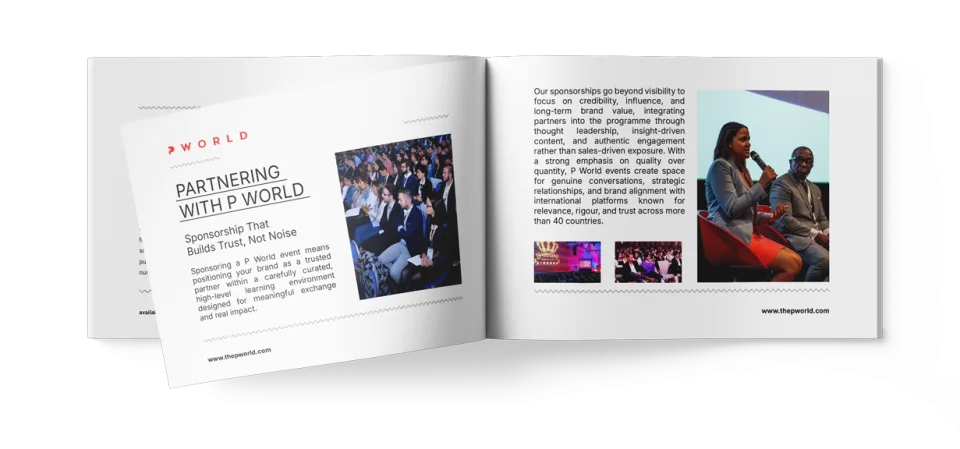
Download our Sponsorship Brochure
Explore all sponsorship packages, benefits, and pricing.
This program can also be delivered as a tailored in-house training for your organization. We adapt the content to your industry, objectives, and level of maturity, focusing on real challenges your teams face and the decisions they need to make. In-house formats allow your people to align on a shared approach, work through relevant scenarios, and build skills they can apply immediately.
If you’re exploring an in-house option, tell us a bit about your team, priorities, and timing, and we’ll recommend the right format.
Contact us about in-house training
